Just a geek who lives in Olympia, WA with my wife, son, and animals. In my free time I play board games, write fiction, and make stuff.
597 stories
·
4 followers

Pike Place Market Pedestrianization Pilot Boosts Sales and Visits

1 Share
Pike Place Market Pedestrianization Pilot Boosts Sales and Visits

Limiting car access to Pike Place to better welcome foot traffic has been a boon to Pike Place Market visitation and sales, according to newly released data. Commercial tenant sales rose 6.5% in 2025 compared to 2024, after the implementation of a "test and learn" pilot vehicle access strategy at Pike Place Market early last spring.

Sales at retail stores within the Market rose 9.2%, with restaurants seeing a 10.2% boost between May and September, the busiest season at Seattle's most popular public market. The number of visitors who live within 30 miles of the Market increased by 5.6% from one year to the next, a figure that translates to an additional 127,000 Puget Sound residents dropping by Pike Place at some point in 2025.

These new numbers, presented to the Pike Place Public Development Authority (PDA) Executive Committee last week, strongly bolster the case for considering permanent pedestrianization infrastructure at the Market. Under the pilot, vehicle access to Pike Place is restricted from 10am to 4pm everyday, with exceptions provided for drivers making deliveries, those needing ADA access, and emergency vehicles, with all drivers able to access the street earlier in the morning and in the evening.

Pike Place Market Pedestrianization Pilot Boosts Sales and Visits
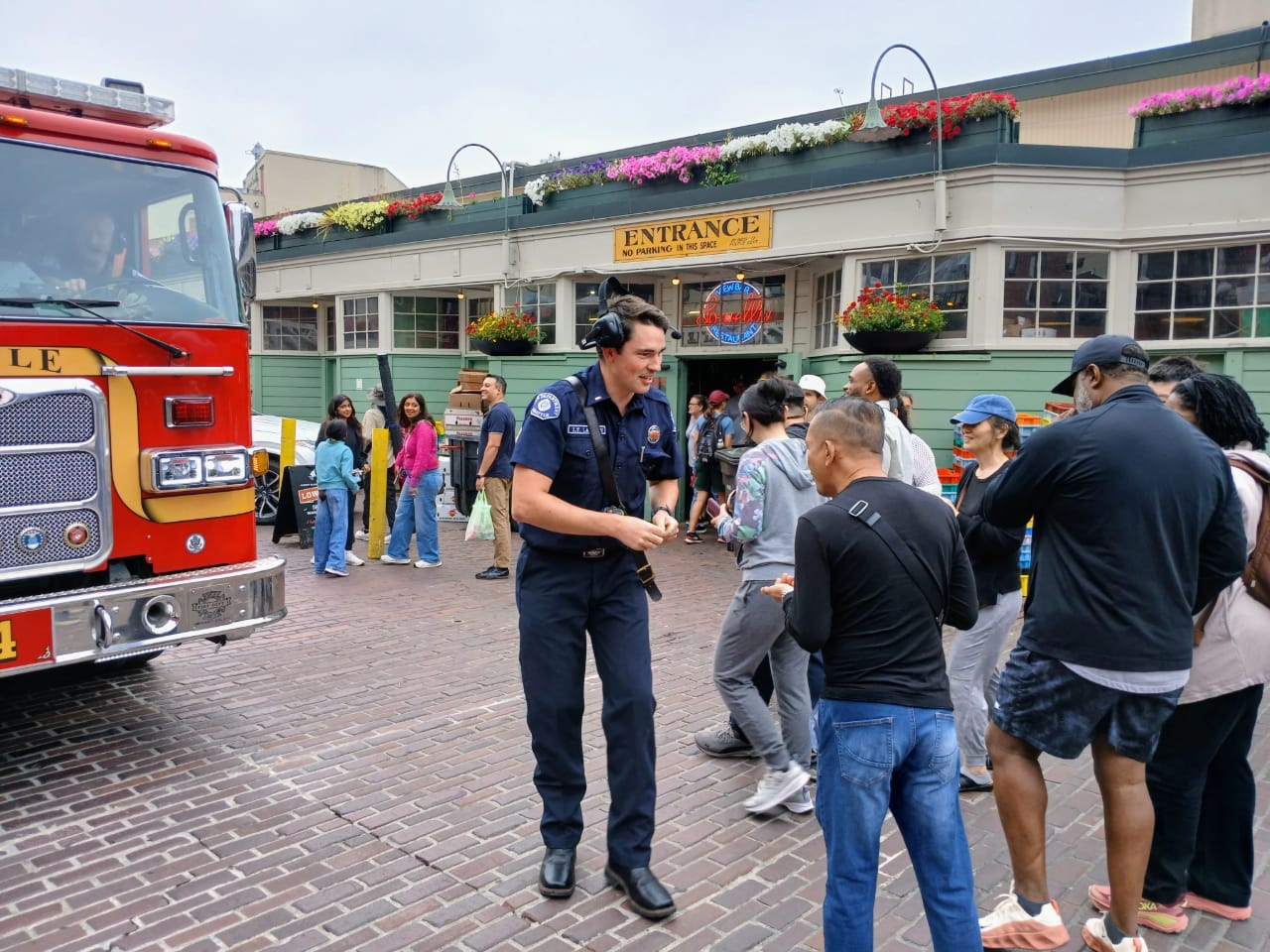
A Seattle Fire Department employee hands out stickers to Market visitors during the peak of the 2025 summer tourist season. (Ryan Packer)

Initially set to last a year, the pilot has been extended at least through Labor Day of 2026, as PDA leaders – tasked with managing day-to-day operations at the Market – work with city officials and other stakeholders to determine what the Market's new normal will be.

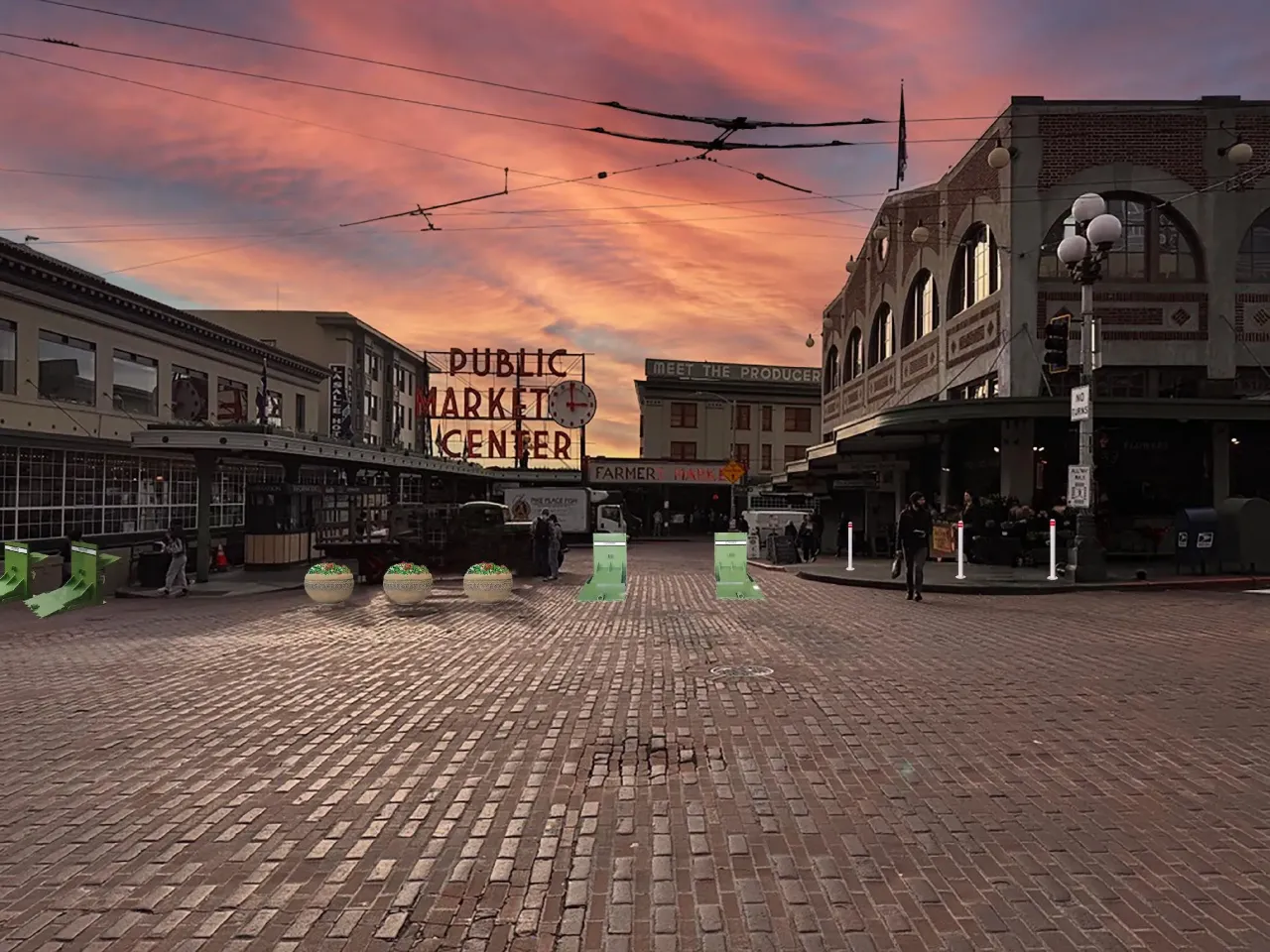
In the coming weeks, the Seattle Department of Transportation (SDOT) will install additional hardening infrastructure at the Market's primary entrances, changes that will allow full closures of Pike Place on FIFA Men's World Cup match days. Those updates include bollards along sidewalk edges that will prevent any drivers from ignoring new movable, crash-rated barricades of the type commonly seen near parade routes.

The Market Historical Commission, a City-established board that oversees the historically-designated preservation district encompassing the entire Market, granted temporary approval for these changes that only extends until this fall.

Pike Place Market Pedestrianization Pilot Boosts Sales and Visits
The interim vehicle barrier plan for Pike Place includes sidewalk-mounted bollards and crash-rated barricades. (SDOT)

Ultimately, the 2025 data backs up what seems crystal clear in practice to many Seattleites: blocking a relatively small number of drivers from being able to careen down the middle of Pike Place at their leisure at any time of day has made one of Seattle's most iconic public spaces much more welcoming.

"I can speak to my experience over the months that this pilot has been going, and say that it's been an immense improvement," Seattle resident Soren Smith told the historical commission in February, as it was considering whether to approve the interim vehicle barriers. "I think that limiting who's allowed would make it easier to get deliveries in and out, [and] make it easier for longtime, valued customers who may, for whatever reason, need to drive to the Market to get in and not have to deal with just the continual line of traffic from one end to the other down the main street that was there for most of the day prior to the pilot."

Pike Place Market Pedestrianization Pilot Boosts Sales and Visits
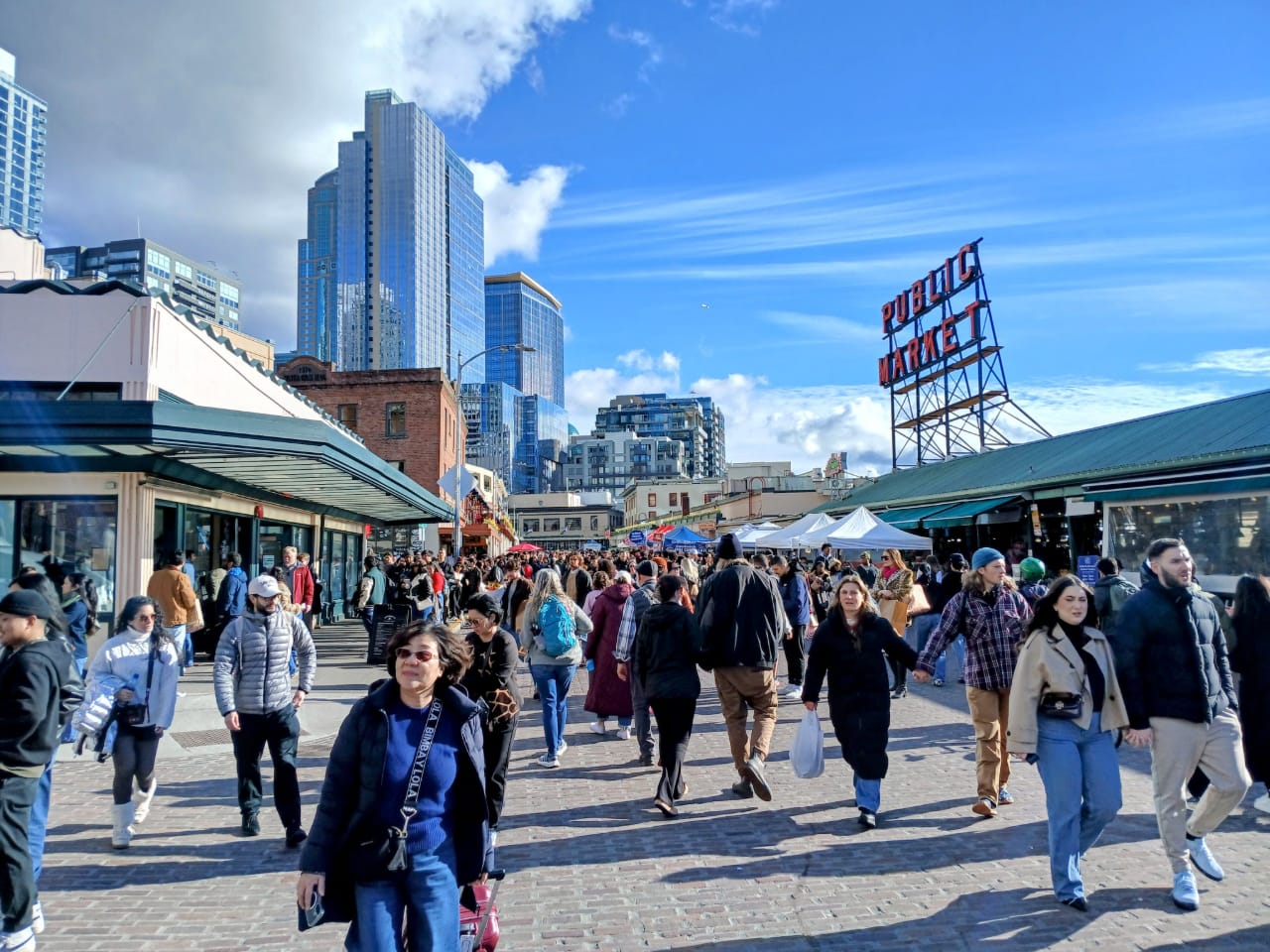
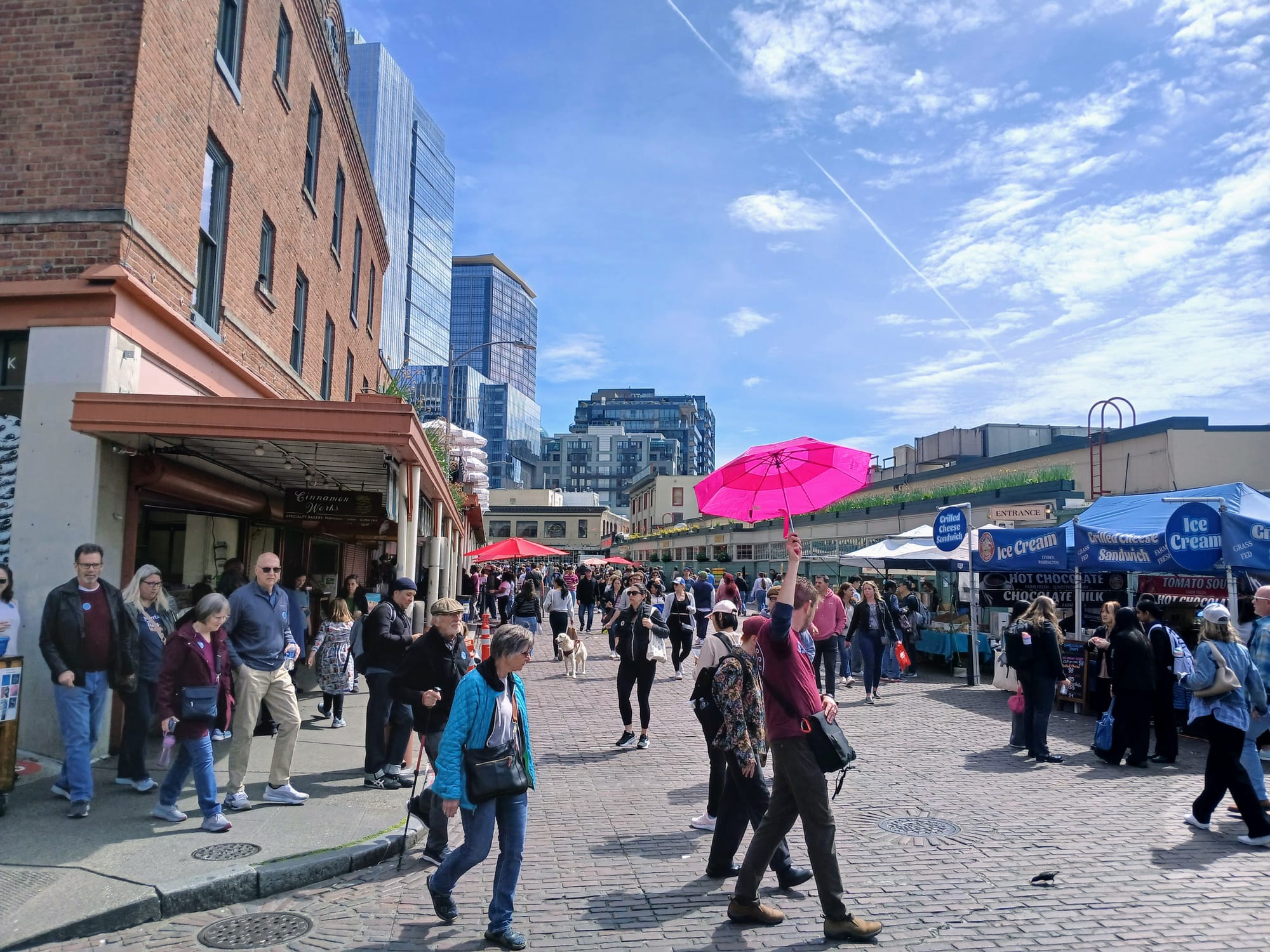
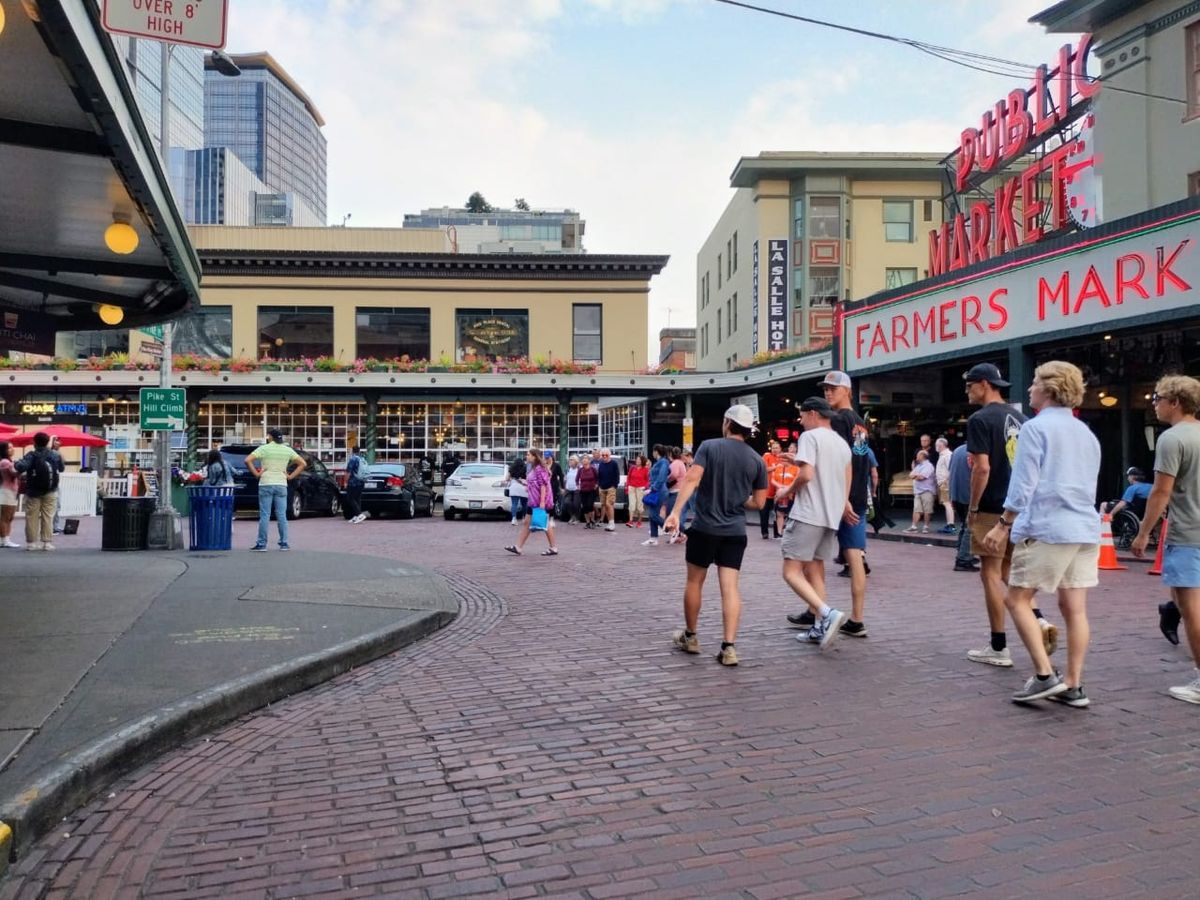
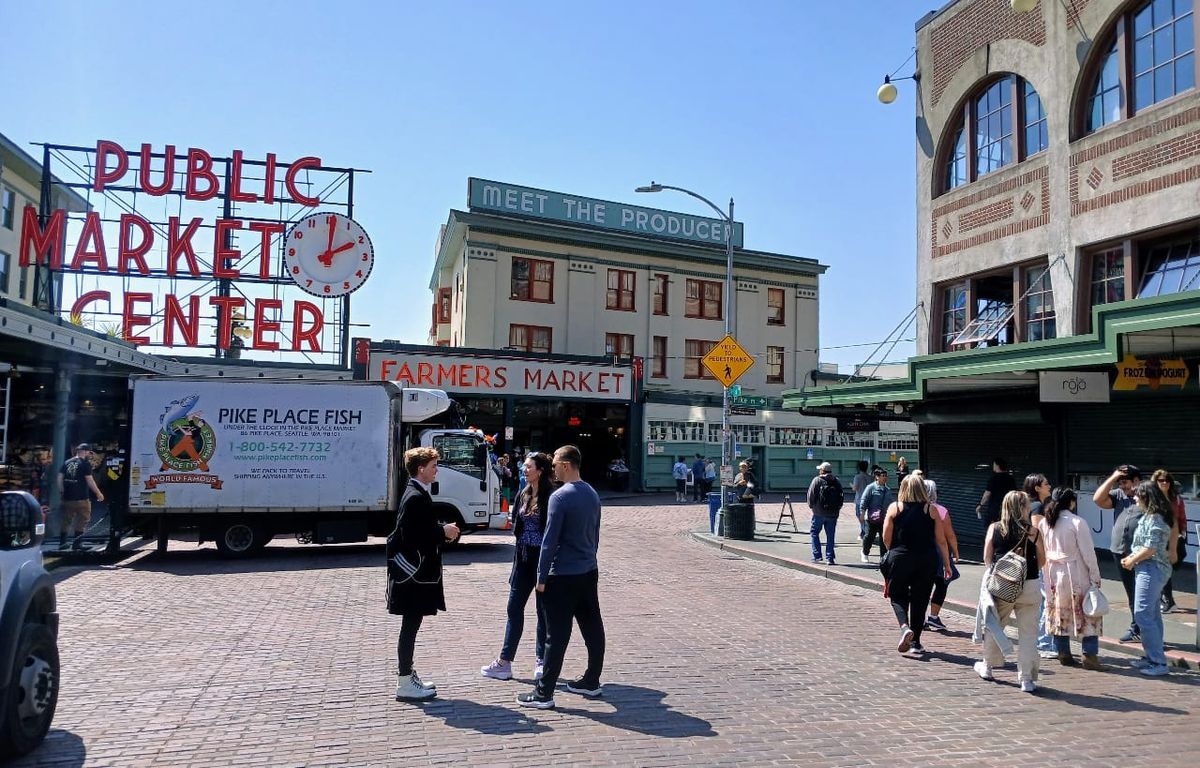
With most vehicles restricted from using Pike Place, the street has been bustling on most days with residents joining tourists in exploring the Market. (Ryan Packer)

Which is not to say that everyone's onboard – far from it. Some of the most skeptical voices when it comes to access changes have been members of Friends of the Market, the advocacy group formed in 1964 to push for preservation of the Market in the face of potential proposals that would have seen it demolished. The group, which is provided two votes on the Market Historical Commission, is just one element of a complex ecosystem of groups that are seen as direct stakeholders when it comes to any potential changes to the Market. (Full disclosure: I served on the Friends of the Market board between 2014 and 2016.)

"While those who want the street closed might wax rhapsodic about the joys of being able to meander down the middle of a car-free street, there are businesses who tell of losing long-time customers to the confusion of encountering STREET CLOSED signs at Market entrances thoughout [sic] much of the day for most of last year," Christine Vaughan, a Friends board member, wrote in the organization's monthly newsletter this month. "Some of these businesses are the legacy grocery sellers: businesses that have been at the Market for 40 or 50 years or even longer, now severely impacted to the point of questioning the viability of continuing their presence in the Market."

Despite the PDA's data showing that produce sales were up 8.1% year-over-year, some produce vendors have indeed voiced concerns about losing their existing customer base.

"Customers come in cars. That's the thing. In the advent of opening up the waterfront, they took away 300 parking spaces and didn't replace them with anything. Now, they're expecting people to come down and there's nowhere to park," Mike Osborn, the owner of Sosio's Produce, told KING 5 last year.

In fact, the Marketfront, the new addition to the Market facing the waterfront that opened in 2017, came with 300 parking stalls that went a long way to replacing the parking stalls that used to sit under the long-demolished Alaskan Way Viaduct. That garage supplements the hundreds of additional parking stalls available around the Market. The number of parking spaces along Pike Place pales in comparison to the number of off-street stalls, but many longtime Market advocates have been pushing for SDOT to increase the amount of time customers can park along the street to accommodate longer shopping trips.

But even surveys of Market business owners had shown that the idea of pedestrianizing the street was broadly popular – before this new data showing the positive impact on sales and visits across the entire district.

The future of the Market is set to come back into the spotlight this fall, after a working group develops recommendations that are set to inform SDOT's request to the historical commission. As hinted by SDOT staff working on the project, that recommendation could include installation of retractable bollards.

In the meantime, the first deployment of the vehicle barricades as part of a full closure of Pike Place is expected on May 9, for Pike Place's 18th Annual Flower Festival.

Market to Test Out Long-Requested Pike Place Car Ban » The Urbanist
# Car access to Pike Place’s main corridor will be restricted to loading vehicles, emergency access, and people accessing ADA parking. The Market is calling the move a “test and learn” opportunity that could open the door to long-term pedestrianization.
Pike Place Market Pedestrianization Pilot Boosts Sales and Visits
Vehicle Barrier Plan for Pike Place Market Comes Into View » The Urbanist
# SDOT’s plan for adding barricades ahead of this summer’s World Cup leans heavily on planters and movable barricades. While the infrastructure could ultimately form a template for longer-term upgrades, these changes look to be quick and dirty and aimed at protecting pedestrians as Seattle opens itself to the world stage.
Pike Place Market Pedestrianization Pilot Boosts Sales and Visits

Read the whole story
Share this story
Delete

The Small Power of Photos, the Large Power of Enforcement

1 Share

In 1961, if you wanted to teach at Olympia High School, you had to show the district exactly what you looked like. Before anyone looked at your degree or your references, they looked at your face. This wasn’t just about record-keeping. This was an era when racial discrimination was common in Olympia but rarely admitted in public. A mandatory headshot was an incredibly effective gatekeeping tool. It allowed the district to maintain a white faculty without ever having to say a word about race out loud.

The State Board Against Discrimination eventually stepped in and told the Olympia School District to stop. The district didn’t just disagree. They took the board to court to fight for their right to require those photos. This legal battle lasted nearly two years. The board argued that a photograph was a graphic specification of an applicant’s race. They said it was just as revealing as requiring applicants to write down their race on the form. Their lawyers pointed out that photographs mainly provide information about physical beauty. Unless beauty was a requirement for teaching, they argued, the policy was a direct violation of state law.

Superintendent Rolland Upton led the defense for the school district. He claimed the photos were just for reference. He said the images helped officials judge professional dignity and personal appearance. The district’s lawyers even argued that because an in-person interview would reveal race anyway, the photo wasn’t the primary tool for discrimination. 

That argument is hard to take seriously. A photo allows a recruiter to toss an application into the trash immediately. It ensures that a minority applicant never even gets the chance to prove themselves in an interview.

Upton’s defense feels hollow when you look at the rest of Olympia’s history. Discrimination wasn’t an accident here. It was built into the system. Ten years before this court case, racially restrictive covenants were still being filed in Thurston County. These were documents that barred non-white people from owning certain homes. They were filed years after the Supreme Court ruled they couldn’t be enforced.

We know these barriers were real because local historians like Thelma Jackson documented them. In her book, Blacks in Thurston County, Washington: A History, she explains how Black residents were treated when they arrived. Real estate agents would simply, without explanation or excuse, refuse to show them homes in specific neighborhoods. It is hard to believe that a school district in that same environment would magically ignore the race of an applicant. Given what we know about Olympia in the 1960s, it’s clear the photos acted as a silent filter.

Research since then backs up what the board suspected back then. We know that visual cues trigger deep biases. When Upton talked about professional dignity, he was likely using a code word. Recruiters often equate professional looks with white beauty standards. This makes people of color seem less capable before they even speak. The board was right to call the photo a graphic specification. A headshot is the strongest signal of race an applicant can provide.

There’s even a technical side to this exclusion. Historically, color film was calibrated using Shirley Cards. These cards featured white models and were used to set the color balance for developing photos. Because the technology was designed for white skin, photos of Black people often lacked detail and texture. Researchers believe this helped promote bias by making minority faces look less human or expressive in print.

This wasn’t just about aesthetics. It was about economics. By using these look policies, the district could cultivate an all-white workforce. This was segregation disguised as a preference for appearance. The consequences were real. Even today, studies on sites like LinkedIn show that Black profiles get fewer responses. By mandating photos in 1961, the Olympia School District put Black educators at an immediate disadvantage. This led to lost careers and long-term wage gaps.

The legal side of the story is just as messy. The local Thurston County judge, Charles T. Wright, originally sided with the school district. He ruled that the board had gone too far. He didn’t think a simple request for a photo proved an intent to discriminate. It was a very narrow way of looking at the law. It ignored how systemic racism actually works. The board appealed to the State Supreme Court. This time, they won. The high court issued a unanimous decision. They ruled that under the specific laws of that time, orders issued by the board against government agencies were not subject to judicial review.

This was a huge win for the commission. It re-established their power to stamp out discriminatory practices in city governments and school districts without getting stuck in long court battles. When the board was first created in 1949, it was weak and underfunded. It didn’t have much power to change things. But by the 1960s, groups like the Congress of Racial Equality were putting on pressure. The state legislature eventually expanded the board’s reach. They started looking at discrimination in housing and public spaces, too.

By 1970, the agency had grown into a much more visible force. It eventually became the Washington State Human Rights Commission. Cases like the one in Olympia fueled this growth. The state had to decide whether to protect the preferences of white officials or the civil rights of its citizens.

Because of the Supreme Court ruling, the ban on photos was upheld. Superintendent Upton had to announce that the district would change its forms. They finally removed the space for the photograph. It was a clear victory. But the people who lost weren’t finished. Some board members suggested they should change the law so they could appeal these decisions in the future.

That’s exactly what happened five years later. In 1971, the legislature rewrote the law. They gave the commission its new name, the Washington State Human Rights Commission. But they also gave other public agencies the right to appeal the board’s decisions. The board had won the battle over the photos, but the legislature had quietly cancelled the war. School boards and city councils found a way to tie the commission’s hands again.

Institutional racism doesn’t need a loud voice. It can work through small rules and administrative details. The Olympia School District didn’t have to say they were discriminating. They just had to say they wanted to see who was applying. But in 1961, seeing was a form of sorting. 

Progress also isn’t a straight line. Every time a barrier is removed, the system can find a quieter way to rebuild it.

This is why the work of people like Thelma Jackson is so important, because it keeps these stories alive. It prevents institutions from rewriting their own history. The 1961 photo case was an early version of the debates we still have today about bias in hiring, banking, policing, and our everyday practices.

This history also shows how far and deep the work to reverse the damage we’ve done in our communities goes. It reminds us that equity isn’t just about changing a form or a policy. It requires a constant, active commitment to tearing down the walls that were built to be invisible.

Read the whole story
Share this story
Delete

DoS That LLM Till It’s 404

1 Share

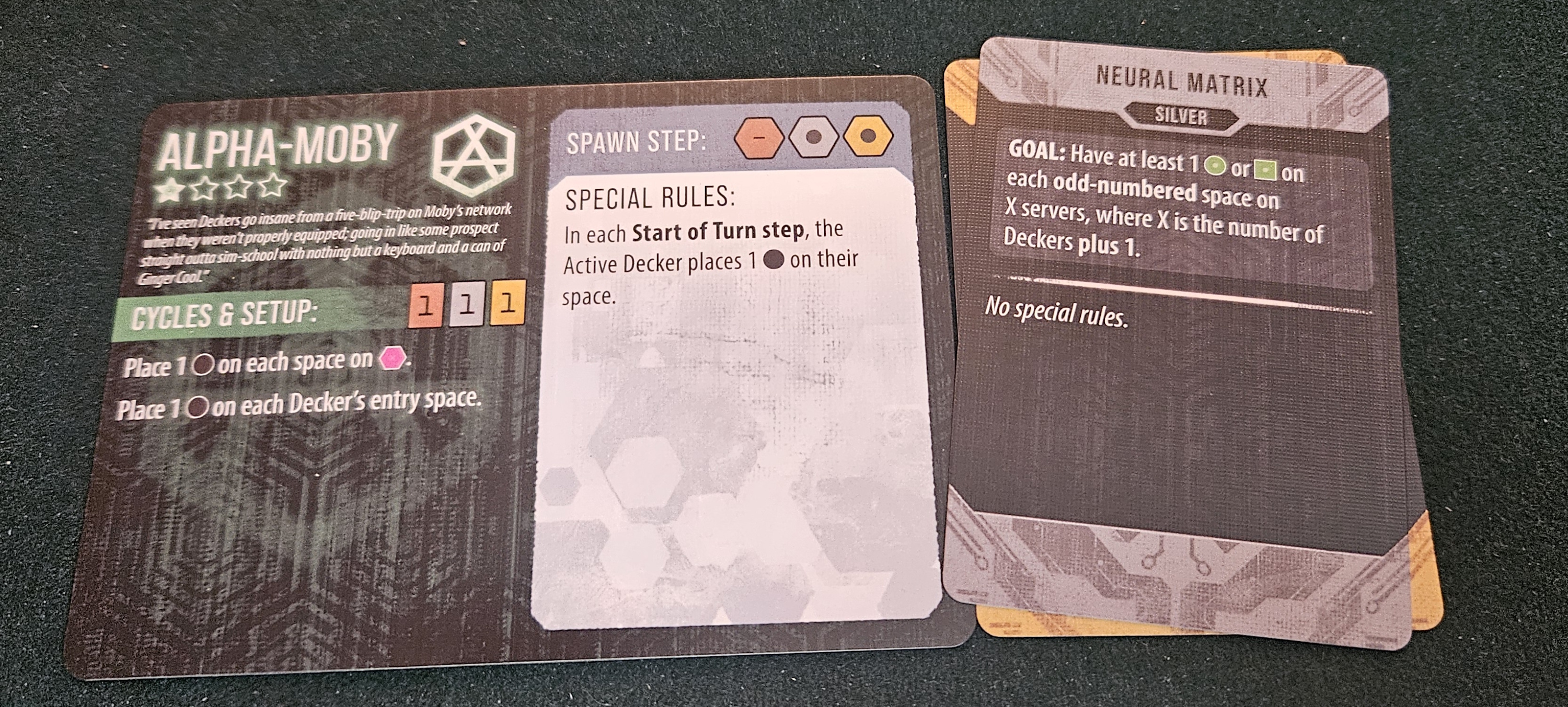
better than the frat house game UPPER DECKERS, anyway

There’s history to Deckers. Pedigree. Richard Wilkins — better known by the epithet Ricky Royal, the name under which he’s created a bunch of incredible solitaire modes for games that wouldn’t otherwise suit solo play in the slightest — designed a ditty called Renegade back in 2018. Before the plague years. Before the world’s billionaires started cramming robo-slop down our throats and calling it nourishment.

Before, in other words, cyberpunk felt quite so urgent. Back when the genre was a throwback to ’80s techno acceleration and not ’20s techno throttling.

Deckers is Renegade. That’s the short version. The slightly longer version is that Deckers is Renegade, but decoupled from the vulture who acquired it along with the rest of the Victory Point Games catalog, and with the expansion packs folded in, some additional clarity and development, and a new coat of paint. It won’t persuade anybody who didn’t get along with the original, but it’s just as fresh as ever. And as infuriating.

This is how he appears in a corpo's office. With a hot-pink katana.

Man of mystery. And mood-setting backlighting.

Like all cyberpunk games, Deckers is about jacking into an encrypted network that’s inexplicably neon. There’s some technobabble about a supercomputer run amok, how society’s last chance hinges on a team of keyboard jockeys sticking it to the man by typing stuff on the internet. But we all know why we’re really here. To kill Grok. To murder OpenAI. To finally figure out how to remove the smart features from Windows 11. If we play our cards right, to fry the dopamine-jack in Sam Altman’s head.

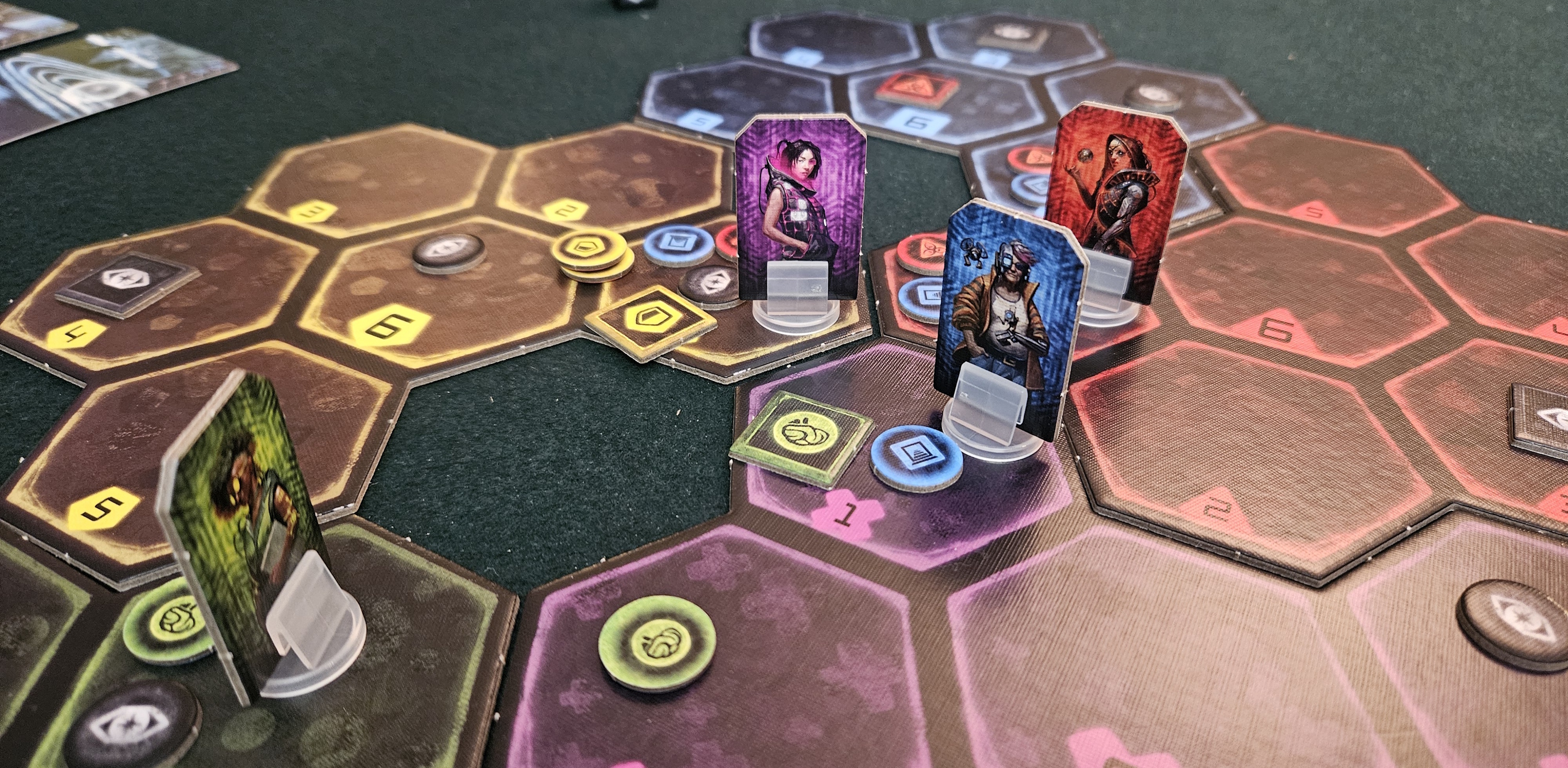
The game’s first impressions are… let’s call them “mixed.” The network is a blob of color-coded hex grids. The game’s terminology is heavy with “SMCs” and “sparks” and “ghosts.” There are heaps of actions, and modifiers to those actions depending on the color of the icons you trigger them with.

And then there’s the mission structure. Scenarios in Deckers aren’t scenarios so much as they are accumulations of objectives. First you pick which SMC you’ll be decking. (See? I told you there would be terminology.) Then you populate that SMC with objective cards. These range from the simple to the confounding. Sometimes they’re clear enough, like generating a network keycode by installing four different programs on your decker’s entry point. Other times, they tip over the edge into a nihilism of iconography. A couple plays ago, we flipped the final objective and discovered we were meant to create a “mirror map.” Every server on the table, all five of them, were to have an identical configuration of programs, both friendly and rival, with at least one program of the four primary types. Such a goal might be easy or might be hard, depending on how well the mission had been going up to that point and whether the current SMC would add and/or shift lots of nasty counterintrusion programs, but it will never seem like anything other than the sort of busywork a teacher hands out to their fifth-grade students when there’s only forty-five minutes left in the day and she’s come down with another migraine, dammit.

Shades of that silly Microsoft CEO who's always calling LLMs "cognitive enhancers" like the world's yuckiest irony.

Bootin’ up my Win11 PC, callin’ it NOOTROPIC BLOOM.

Now, you might be thinking that I’m not putting Deckers on the strongest footing. You’d be right. But I want to emphasize this point. Deckers is not for the faint of heart. Despite resembling Pandemic in a few superficial ways, it’s crowded with icons and ideas and actions and colors and special powers and objectives that require a few re-reads before they make a lick of sense.

But it’s also modular. In the case of our misbegotten mirror map, we goggled at the objective’s preposterousness for a bit, then drew a much more reasonable replacement. There are loads of customization options. And as much as I’m can grow irritable at a game asking me to set its difficulty level rather than providing me with an intended experience, I can’t help but appreciate the way missions unspool on their own, coughing up new problems according to some imperceptible aleatory logic.

More than that, the game’s thicket of information is a not-insignificant part of its appeal. To play Deckers is to step into the boots of a troubleshooter. Where most cooperative and solitaire games present a puzzle, Deckers presents a problem. Often that problem is multilayered, difficult to discern, and seems impossible at first glance.

The other thing Deckers provides, though, is a toolkit. More than a toolkit. An entire tool shed, full of power appliances and extension cords and, oh, here’s a weed whacker and some fertilizer. Maybe a pool pump just in case.

At its most basic level, Deckers is a deck-building game, although like everything else this is an inadequate description. It’s not so much about deck-building as it is about deck-renovating. You have fifteen cards when the game opens. You’ll have fifteen when it ends. In the middle, you can purchase cards that swap into the place of previous cards. This keeps the game pacey, not to mention erases the usual bloat that accompanies deck-building.

*glances at Wee Aquinas on my site header* oh no. oh no oh no.

You do you, but my decker avatar wouldn’t be a middle-aged shlub.

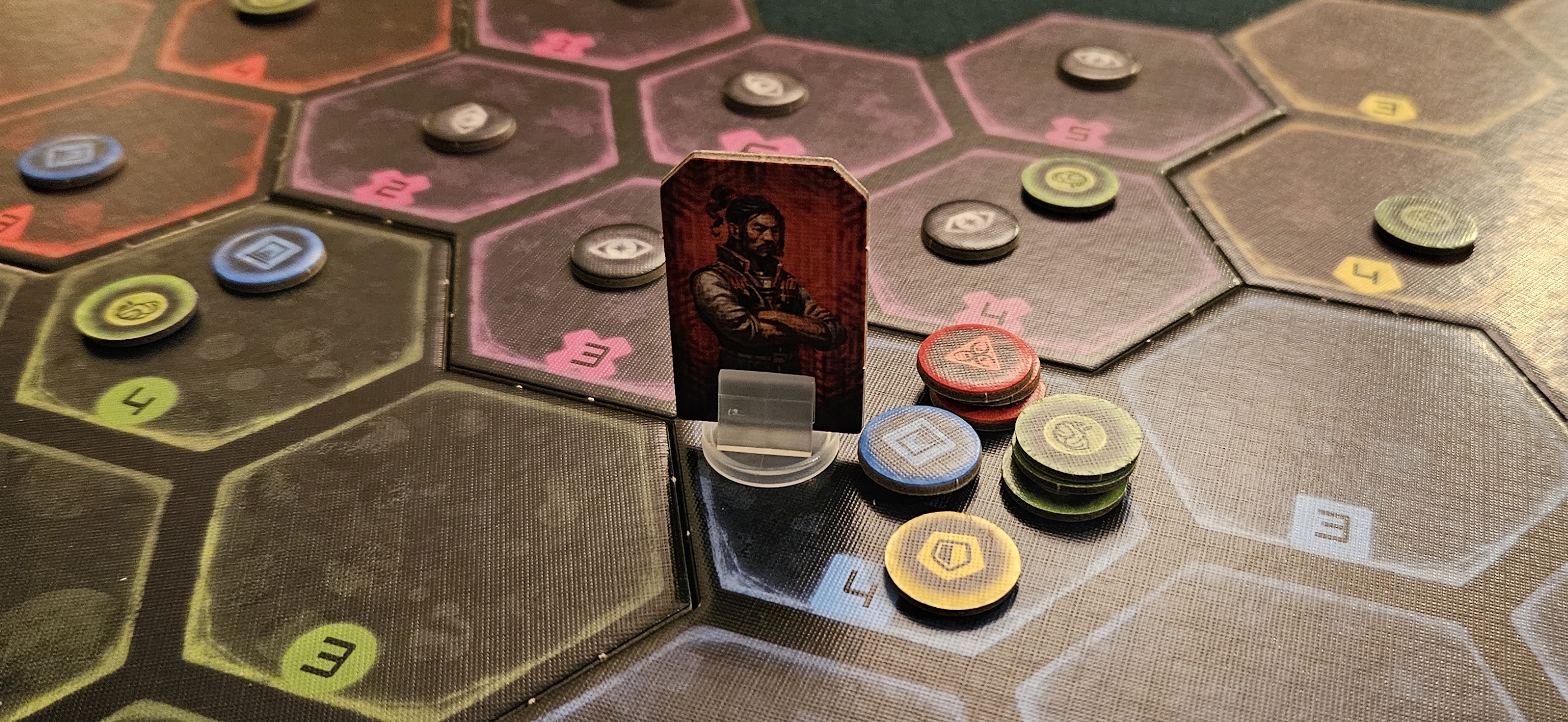
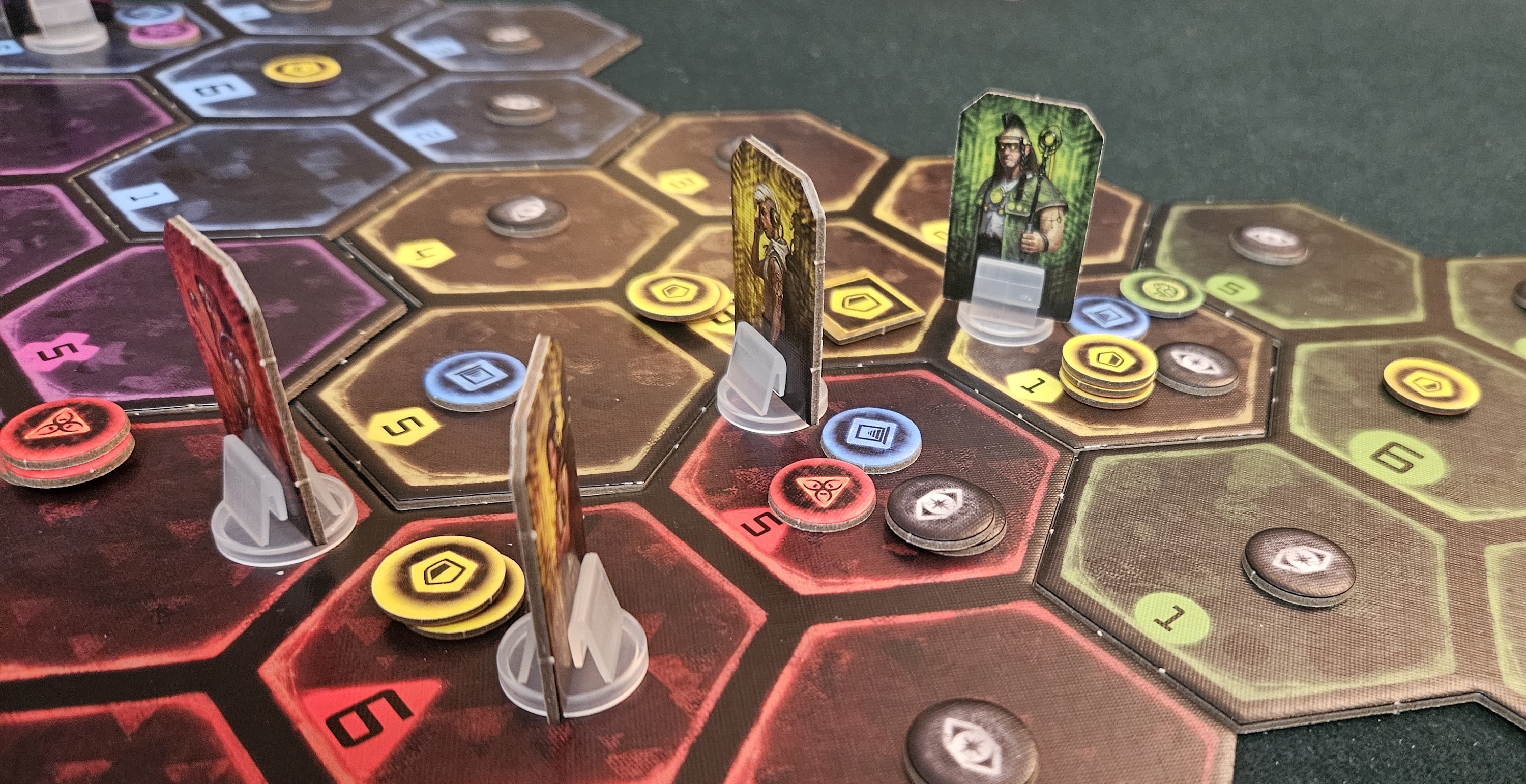
What’s more, those cards put in the work. Before long, the network will be speckled with color. Programs, the little round tokens, each have their own functions, such as attacking enemy sparks (red and yellow), permitting easier movement through cyberspace (blue), or rearranging other bits of data (green). Programs eventually transform into installations, the larger boxy tokens, which are even better at attacking, permitting movement, or rearranging data. Sometimes they’re so much better that you can teleport around the network at will or project a ghost image of your character to another position entirely.

That network, meanwhile, becomes textured not because of any inherent topography, but thanks to the addition and movement of the game’s various threats and the consequences of your activities. Perhaps an information superhighway of blue and green tokens will take shape, allowing your deckers to race along it with impunity, shuttling programs where they need to go and dousing fires wherever they appear. Or maybe an incursion by the SMC will transform a corner of the network into a minefield of enemy sparks and guardians, necessitating a gradual campaign of reclamation lest they blossom, Pandemic-style, into an early loss.

The same goes for the game’s underlying problems and their various solutions. It’s rare that one of these problems will present a straight line from A to Z. Instead, the game meanders. In one mission, when a corporate decker appeared to ice our asses, we were prohibited from entering his space at all. How then, could we beat him? We eventually set up a green installation, ghosted into his space, pushed viruses into position from neighboring hexes, and then engaged in an epic roll-off. Everyone at the table was invested. Attention-wise, sure, but also because they had been churning their decks to find the cards that could massage the outcome of our climactic roll. The solution was messy, inelegant, and harried by ancillary problems. It took coordination, not to mention required everyone to work to mitigate the game’s chancier elements.

In the process, it became closer to real-world problems and their real-world solutions than most board games manage. We weren’t solving some graceful puzzle. We were patching over a memory leak and hoping it wouldn’t crash the whole network. Are those things? I have no idea. But that’s what Deckers feels like.

Hey. I never realized it until this moment, but “Deckers” is a pun. Decking-in. Deck-building. Heh.

"Didja hear? Sheepang Deedrip got Deep Sixed by Boop Scoop for working the Muzzlers. You pang?"

“I’ve seen deckers go insane from a five-blip-trip on Moby’s network…”

To be clear, Deckers never fully escapes its issues. Even at its best, it can grow fiddly with all those tokens, and there’s always the chance that a new objective will prove just an action or two shy of being solvable. Even the deck-building feels flashy but isn’t wholly interesting, more about fine-tuning cards into better versions of themselves than altering a deck into something new.

But maybe that’s how it ought to be. Even when it was called Renegade, Deckers was something of a throwback. I’m old enough to remember when the prevailing wisdom for cooperative games was that they should only be winnable one in three plays. Nowadays, most board games are tuned to provide a solid first session, because in all likelihood that’s all they’re ever going to get. The unfortunate trickle-down is that most cooperative games are easy, which is to say dull, which is to say they’re boring.

There are moments when Deckers is boring, but it’s a very different sort of boring. It’s not the boredom of tedium; it’s the boredom that arises when a problem is inscrutable and so our mammalian instincts tell us to hibernate rather than facing the issue with our whole chest. It’s like hearing that human civilization is killing the oceans or running out of freshwater. Why worry about that stuff? Easier to take a nap.

In a way, that’s what makes Deckers worthwhile. Because these folks could have taken a nap, too. Just look at them. Some of the game’s characters are classic cyberpunk. Leiko Mori is a chick in a leather vest illuminated by purple LEDs. Oshin Noro is more or less a samurai. Two of them are twins with USB-Zs plugged into their ears. But there’s an appropriate shlubbiness to the rest of the cast. Tilda Sweet cut my hair once. Monty Quantum is the guy who mains a druid. Hettie Magnetic is prediabetic. They’re a little more into body modification than the average Joe, but they’re surprisingly ordinary. It’s just that they’re willing to put their principles into practice when it comes to AI slop. Their solutions are messy workarounds. Sometimes they fall apart. And sometimes I cheat by drawing a different objective card because the last one read like a word problem. Hey, that’s why I play board games. Because they’re ours.

ruh roh we overheated the coolant tower of the local server farm that ran on baby calories oh nooooes

Check out these cool kids and their cool hobbies.

That’s all to say that Deckers is something special. Not only in spite of its problems, but because of them. In credit to them. This is a compact, dense game, produced and presented on a budget, and I like it all the better for that too. It’s a big rowdy mess that sometimes falls apart at the edges, and in fact is never better than when you’re asked to tug at its fraying strands. Down with the slop. Up with the folk who decided it was better to keep their avatar paunchy. Welcome to the revolution, pal.


A complimentary copy of Deckers was provided by the publisher.

(If what I’m doing at Space-Biff! is valuable to you in some way, please consider dropping by my Patreon campaign or Ko-fi. Right now, supporters can read about which films I watched in 2025, including some brief thoughts on each. That’s 44 movies! That’s a lot, unless you see, like, 45 or more movies in a year!)


Read the whole story
Share this story
Delete

Researchers: New maps reveal U.S. post-flood migration patterns after FEMA buyouts

1 Share
Flood waters cover Sumas in northern Whatcom County this week. The city has faced major flooding at least twice since 2021. (Isaac Stone Simonelli/Cascadia Daily News)

Dangerous flooding has damaged neighborhoods in almost every state in 2025, leaving homes a muddy mess. In several hard-hit areas, it wasn’t the first time homeowners found themselves tearing out wet wallboard and piling waterlogged carpet by the curb.

Wanting to rebuild after flooding is a common response. But for some people, the best way to stay in their community, adapt to the changing climate and recover from disasters is to do what humans have done for millennia: move.

Researchers expect millions of Americans to relocate from properties facing increasing risks of flood, fire and other kinds of disasters in the years ahead.

What people do with those high-risk properties can make their community more resilient or leave it vulnerable to more damage in future storms.

We study flood resilience and have been mapping the results of government buyout programs across the U.S. that purchase damaged homes after disasters to turn them into open space.

Our new national maps of who relocates and where they go after a flood shows that most Americans who move from buyout areas stay local. However, we also found that the majority of them give up their home to someone else, either selling it or leaving a rental home, rather than taking a government buyout offer. That transfers the risk to a new resident, leaving the community still facing future costly risks.

FEMA’s buyout program at risk

Government buyout programs can help communities recover after disasters by purchasing high-risk homes and demolishing them. The parcel is then converted to a natural flood plain, park or site for new infrastructure to mitigate future flood damage for nearby areas.

FEMA has been funding such efforts for decades through its property buyout program. It has invested nearly $4 billion to purchase and raze approximately 45,000 flood-prone homes nationwide, most of them since 2001.

Those investments pay off: Research shows the program avoids an estimated $4 to $6 in future disaster recovery spending for every $1 invested. In return, homeowners receive a pre-disaster price for their home, minus any money they might receive from a related flood insurance payout on the property.

But this assistance is now in jeopardy as the Trump administration cuts FEMA staff and funding and the president talks about dismantling the agency. From March to September, governors submitted 42 applications for funding from FEMA’s Hazard Mitigation Grant Program, which includes buyouts – all were denied or left pending as of mid-September.

Our recommendation after studying this program is to mend it, not end it. If done right, buyouts can help maintain local ties and help communities build more sustainable futures together.

Buyouts vs. selling homes in damaged areas

Our team at Rice University’s Center for Coastal Futures and Adaptive Resilience developed an interactive mapping tool to show where buyout participants and neighbors living within a half-mile of them moved after FEMA initiates a buyout program in their area.

The maps were created using individual data, down to the address level, from 2007 to 2017, across more than 550 counties where FEMA’s buyout program operated nationally.

Zoomed out, they show just how many places the program has helped across the U.S., from coastal cities to inland towns. And, when zoomed in, they reveal the buyout locations and destinations of more than 70,000 residents who moved following FEMA-funded buyouts in their area.

A map shows buyouts in cities scattered across the country.
FEMA’s buyout programs have helped homeowners and communities across the U.S., in almost every state. James R. Elliott, CC BY

The maps also show which people relocated by accepting a federal buyout and which ones relocated on their own. Nationwide, we see the vast majority of movers, about 14 out of every 15, are not participants in the federal buyout program. They are neighbors who relocated through conventional real estate transactions.

This distinction matters, because it implies that most Americans are retreating from climate-stressed areas by transferring their home’s risk to someone else, not by accepting buyouts that would take the property out of circulation.

Selling may be good for homeowners who can find buyers, but it doesn’t make the community more resilient.

A map show lines from red dots to locations where people moved.
A map of buyouts in Sayreville, N.J., shows most people didn’t move far away. James R. Elliott, CC BY

Lessons for future buyout programs

Our interactive map offers some good news and insights for buyout programs going forward.

Regardless of how they occur, we find that moves from buyout areas average just 5 to 10 miles from old to new home. This means most people are maintaining local ties, even as they relocate to adapt to rising climate risks.

Nearly all of the moves also end in safer homes with minimal to minor risk of future flooding. We checked using address-level flood factors from the First Street Foundation, a nonprofit source of flood risk ratings that are now integrated into some online real estate websites.

But many homes in risky areas are still being resold or rented to new residents, leaving communities facing a game of climate roulette.

How long that can continue will vary by neighborhood. Rising insurance costs, intensifying storms and growing awareness of flood risks are already dampening home sales in some communities − and thus opportunities to simply hand over one’s risk to someone else and move on.

The U.S. can create safer communities by expanding federal, state and local voluntary buyout programs. These programs allow communities to reduce future flood damage and collectively plan for safer uses of the vacated lands that emerge.

Giving residents longer periods of time to participate after the damage could also help make the programs more attractive. This would provide property owners more flexibility in deciding when to sell and demolish their property, while still taking risky property off the market rather than handing the risk to new residents.

James R. Elliott is Professor of Sociology at Rice University; Debolina Banerjee is a Research Analyst at Kinder Institute for Urban Research, Rice University

This Oct. 15, 2025 article is republished under a Creative Commons license from The Conversation, which democratizes knowledge by helping academic experts to write for the public. Read the original article.


Read the whole story
Share this story
Delete

Many Americans Are Open to Car-Free Living

1 Share

Is Americans a “car culture” or are they “car dependent”?  Do they drive because they love driving, or are they in an unhealthy relationship with a substance it would be happy to do without?  Obviously there are plenty of Americans who do love their cars, but here’s more evidence that there are fewer of them than you might think, and that the common “car culture” frame is misleading us.

A new study by Nicole Corcoran and others did a nationwide survey with a striking finding:

We find that nearly one fifth of urban and suburban US car owners express a definite interest in living car-free (18 %), and an additional 40 % are open to the idea. This is in addition to the small share (10 %) of urban and suburban US residents currently living without a car.
Even if just the 18% who are highly interested could stop driving, it would transform our cities and suburbs overnight. But who are these people?
Five key factors are associated with interest in car-free living: having prior experience living without a car, using alternative modes of transportation for at least five percent of trips, lower car dependence, riding transit regularly, and having less enjoyment of travel by private car. Further, we find that car owners interested in car-free living are a diverse group, with few significant associations between interest in car-free living and key socioeconomic or demographic variables.
That last item is the most important:  We should not be making demographic or political assumptions about who potential non-drivers are.  They are everyone, rich and poor, old and young, and of various races and political opinions.
Given the sizable unmet demand for car-free living, we conclude that planners should allow and facilitate car-free and car-lite developments. In practice, this can be done by embracing zoning reform, investing in alternative transportation infrastructure, lowering parking requirements for development, and encouraging mixed land uses, including in residential neighborhoods.

I wish they had dropped the word “infrastructure,” because the fastest things we can do to make car-free live possible for more people is to expand the provision of public transit service.  That means actually running more buses and trains, not just building facilities for them.

I expect to refer to this study frequently, because it pierces the illusion that public transit faces a “cultural” challenge in the US.  Public transit’s problem in the US is that it isn’t very useful.  That’s something we can measure, and change.

Don’t worry about trying to change a culture.  Change the facts and the culture will follow.

The post Many Americans Are Open to Car-Free Living appeared first on Human Transit.

Read the whole story
Share this story
Delete

From Wheelmen to Highways to Bike Lanes: Olympia’s 130-Year Loop

1 Share

On more than one muddy Saturday in the 1890s, groups of Tacoma bicyclists pedaled south toward Olympia, only to turn back in frustration. The road between Nisqually and the capital was a slog, a stretch so notorious that “weekend wheelmen” abandoned their plans rather than push their gleaming new safety bicycles through miles of muck.

For decades, Olympia had already endured the political humiliation of defending its status as the state capital against the ambition of cities Tacoma. So to have Tacoma cyclists literally turn up their noses at the condition of the road to Olympia? For men like Dr. P.H. Carlyon, that was simply too much. If the state capital was going to command respect, it needed passable routes. If the county wasn’t going to build them, Olympia’s elite would do it themselves.

Thus began the first organized effort to construct bicycle paths in Thurston County.

The Bicycle Craze Reaches Olympia

The 1890s bicycle boom wasn’t unique to this region; it was a national mania. The safety bicycle, with two equal wheels, a chain, and pneumatic tires, transformed cycling into a middle-class pastime. By 1897 the U.S. was producing up to two million bicycles a year; by 1900, as many as five million Americans owned one.

As crazes sometimes take a while longer to reach us, Olympia’s residents were still no exception. While the nationwide fascination of bikes crested in 1896, in 1897 we formed the Olympia Bicycle Path Association, which grew into the Thurston County Bicycle Path Association by 1899. The membership rolls read like the social directory of the era: physicians, businessmen, former territorial officials. This was not a club of hobbyists, it was a political organization capable of getting things done.

Building the First Bike Network

The Association’s work didn’t focus primarily on city streets. Olympia’s dirt roads were rough but rideable. Most of their work was on the countryside. The challenge wasn’t commuting; it was leisure. Riders wanted smooth, scenic routes to Woodland (now Lacey), to South Bay, to Tumwater, to Little Rock, and even toward Nisqually, where a connection to Tacoma awaited.

Several projects stand out:

  • Franklin Street Path (1899): Construction began in May and marked one of the first formal, graded bike facilities in Olympia.
  • Little Rock Path (1899): Completed by July and praised as a “splendid path,” it demonstrated the Association’s ability to finish large, coordinated works.
  • Olympia–Tumwater Route: Following Cleveland Avenue to Custer, this corridor provided one of the most useful regional connections.
  • Olympia–Nisqually Path: A bold link aimed at stitching Thurston County into the broader Puget Sound biking network.

In a sense, these paths were the 1890s equivalent of mountain bike trails or ski slopes, recreational amenities more than transportation necessities. Their funding and maintenance depended entirely on public enthusiasm to pay a fee toward the path association. So when the bicycle craze collapsed around the turn of the century, the paths faded too. By 1901, the association was effectively defunct.

But for former association president P.H. Carlyon, his few years of advocating for bike path construction set him up for his career defining task.

Carlyon’s Next Act: From Wheelmen to Earthmovers

Dr. P.H. Carlyon had been the president of the Bicycle Path Association in 1898. Just over a decade later, he would become mayor of Olympia. And from 1910–1911, he oversaw one of the largest landscape transformations in city history: the Carlyon Fill, which used more than two million cubic yards of dredged material to reshape what is now downtown Olympia.

In 1913, Carlyon was elected to the state legislature, where he became one of the driving forces behind Washington’s early highway system. Long before the interstate system, Washington built an ambitious network of paved highways connecting cities, routes like Martin Way and Capitol Boulevard that we now take for granted.

It was Carlyon, the former bicycle-path enthusiast, who championed the funding, engineering, and political will for this transformation.

The irony is almost too perfect: the man who once built bike paths so Tacoma riders wouldn’t mock Olympia eventually built the paved roads that would help bicycles vanish from everyday use.

Why the Early Highways Stuck—and the Bike Paths Didn’t

The bicycle paths of the 1890s died because they were built for fun. Highways, on the other hand, were built for commerce, growth, and a modern identity. People had traveled between cities by boat or train. Paved highways were a radical new form of freedom and a new type of economic infrastructure.

Once the state invested in roads, every subsequent decision reinforced the automobile’s dominance. Land was platted for cars. Businesses oriented their entrances around them. Neighborhoods sprawled out to follow them. By the mid-20th century, the original bicycle network was not just forgotten, it was unimaginable.

Today, we can’t picture tearing up paved streets and going back to gravel. The world Carlyon helped build is so complete, so normalized, that even questioning it feels disruptive.

Now, more than a century later, Olympia is again working to expand bike infrastructure. But today’s bike lanes aren’t recreational corridors stretching into the countryside. They’re transportation, intended to help people move within the city, through the very corridors Carlyon and his peers carved out for cars.

Read the whole story
Share this story
Delete
Next Page of Stories