Just a geek who lives in Olympia, WA with my wife, son, and animals. In my free time I play board games, write fiction, and make stuff.
593 stories
·
4 followers

Many Americans Are Open to Car-Free Living

1 Share

Is Americans a “car culture” or are they “car dependent”?  Do they drive because they love driving, or are they in an unhealthy relationship with a substance it would be happy to do without?  Obviously there are plenty of Americans who do love their cars, but here’s more evidence that there are fewer of them than you might think, and that the common “car culture” frame is misleading us.

A new study by Nicole Corcoran and others did a nationwide survey with a striking finding:

We find that nearly one fifth of urban and suburban US car owners express a definite interest in living car-free (18 %), and an additional 40 % are open to the idea. This is in addition to the small share (10 %) of urban and suburban US residents currently living without a car.
Even if just the 18% who are highly interested could stop driving, it would transform our cities and suburbs overnight. But who are these people?
Five key factors are associated with interest in car-free living: having prior experience living without a car, using alternative modes of transportation for at least five percent of trips, lower car dependence, riding transit regularly, and having less enjoyment of travel by private car. Further, we find that car owners interested in car-free living are a diverse group, with few significant associations between interest in car-free living and key socioeconomic or demographic variables.
That last item is the most important:  We should not be making demographic or political assumptions about who potential non-drivers are.  They are everyone, rich and poor, old and young, and of various races and political opinions.
Given the sizable unmet demand for car-free living, we conclude that planners should allow and facilitate car-free and car-lite developments. In practice, this can be done by embracing zoning reform, investing in alternative transportation infrastructure, lowering parking requirements for development, and encouraging mixed land uses, including in residential neighborhoods.

I wish they had dropped the word “infrastructure,” because the fastest things we can do to make car-free live possible for more people is to expand the provision of public transit service.  That means actually running more buses and trains, not just building facilities for them.

I expect to refer to this study frequently, because it pierces the illusion that public transit faces a “cultural” challenge in the US.  Public transit’s problem in the US is that it isn’t very useful.  That’s something we can measure, and change.

Don’t worry about trying to change a culture.  Change the facts and the culture will follow.

The post Many Americans Are Open to Car-Free Living appeared first on Human Transit.

Read the whole story
Share this story
Delete

From Wheelmen to Highways to Bike Lanes: Olympia’s 130-Year Loop

1 Share

On more than one muddy Saturday in the 1890s, groups of Tacoma bicyclists pedaled south toward Olympia, only to turn back in frustration. The road between Nisqually and the capital was a slog, a stretch so notorious that “weekend wheelmen” abandoned their plans rather than push their gleaming new safety bicycles through miles of muck.

For decades, Olympia had already endured the political humiliation of defending its status as the state capital against the ambition of cities Tacoma. So to have Tacoma cyclists literally turn up their noses at the condition of the road to Olympia? For men like Dr. P.H. Carlyon, that was simply too much. If the state capital was going to command respect, it needed passable routes. If the county wasn’t going to build them, Olympia’s elite would do it themselves.

Thus began the first organized effort to construct bicycle paths in Thurston County.

The Bicycle Craze Reaches Olympia

The 1890s bicycle boom wasn’t unique to this region; it was a national mania. The safety bicycle, with two equal wheels, a chain, and pneumatic tires, transformed cycling into a middle-class pastime. By 1897 the U.S. was producing up to two million bicycles a year; by 1900, as many as five million Americans owned one.

As crazes sometimes take a while longer to reach us, Olympia’s residents were still no exception. While the nationwide fascination of bikes crested in 1896, in 1897 we formed the Olympia Bicycle Path Association, which grew into the Thurston County Bicycle Path Association by 1899. The membership rolls read like the social directory of the era: physicians, businessmen, former territorial officials. This was not a club of hobbyists, it was a political organization capable of getting things done.

Building the First Bike Network

The Association’s work didn’t focus primarily on city streets. Olympia’s dirt roads were rough but rideable. Most of their work was on the countryside. The challenge wasn’t commuting; it was leisure. Riders wanted smooth, scenic routes to Woodland (now Lacey), to South Bay, to Tumwater, to Little Rock, and even toward Nisqually, where a connection to Tacoma awaited.

Several projects stand out:

  • Franklin Street Path (1899): Construction began in May and marked one of the first formal, graded bike facilities in Olympia.
  • Little Rock Path (1899): Completed by July and praised as a “splendid path,” it demonstrated the Association’s ability to finish large, coordinated works.
  • Olympia–Tumwater Route: Following Cleveland Avenue to Custer, this corridor provided one of the most useful regional connections.
  • Olympia–Nisqually Path: A bold link aimed at stitching Thurston County into the broader Puget Sound biking network.

In a sense, these paths were the 1890s equivalent of mountain bike trails or ski slopes, recreational amenities more than transportation necessities. Their funding and maintenance depended entirely on public enthusiasm to pay a fee toward the path association. So when the bicycle craze collapsed around the turn of the century, the paths faded too. By 1901, the association was effectively defunct.

But for former association president P.H. Carlyon, his few years of advocating for bike path construction set him up for his career defining task.

Carlyon’s Next Act: From Wheelmen to Earthmovers

Dr. P.H. Carlyon had been the president of the Bicycle Path Association in 1898. Just over a decade later, he would become mayor of Olympia. And from 1910–1911, he oversaw one of the largest landscape transformations in city history: the Carlyon Fill, which used more than two million cubic yards of dredged material to reshape what is now downtown Olympia.

In 1913, Carlyon was elected to the state legislature, where he became one of the driving forces behind Washington’s early highway system. Long before the interstate system, Washington built an ambitious network of paved highways connecting cities, routes like Martin Way and Capitol Boulevard that we now take for granted.

It was Carlyon, the former bicycle-path enthusiast, who championed the funding, engineering, and political will for this transformation.

The irony is almost too perfect: the man who once built bike paths so Tacoma riders wouldn’t mock Olympia eventually built the paved roads that would help bicycles vanish from everyday use.

Why the Early Highways Stuck—and the Bike Paths Didn’t

The bicycle paths of the 1890s died because they were built for fun. Highways, on the other hand, were built for commerce, growth, and a modern identity. People had traveled between cities by boat or train. Paved highways were a radical new form of freedom and a new type of economic infrastructure.

Once the state invested in roads, every subsequent decision reinforced the automobile’s dominance. Land was platted for cars. Businesses oriented their entrances around them. Neighborhoods sprawled out to follow them. By the mid-20th century, the original bicycle network was not just forgotten, it was unimaginable.

Today, we can’t picture tearing up paved streets and going back to gravel. The world Carlyon helped build is so complete, so normalized, that even questioning it feels disruptive.

Now, more than a century later, Olympia is again working to expand bike infrastructure. But today’s bike lanes aren’t recreational corridors stretching into the countryside. They’re transportation, intended to help people move within the city, through the very corridors Carlyon and his peers carved out for cars.

Read the whole story
Share this story
Delete

Confusion wins

1 Share

This is a second blog post reflecting on some of the meta-lessons that came out of local elections in Thurston County this year.

The New York Times recently ran a story about how The Stranger sets the tone in Seattle politics. This is not breaking news for anyone who has watched Seattle politics for the last two decades.

The secret is simple: The Stranger shows up. It is consistently present, consistently relevant, and consistently part of the political conversation.

On a recent episode of The Olympia Standard, campaign consultant Rob Richards talked about the failure of the Workers’ Bill of Rights and how the yes campaign faced an uphill battle from the start. The opposition narrative was already circulating almost a year before the campaign really got rolling. And he’s right. The first public attention the idea got wasn’t from the campaign; it was from a flare-up of misinformation about a possible minimum wage increase more than a year earlier.

The campaign eventually launched with a petition drive last spring, but real messaging didn’t start until August. And in a town with fewer than half a dozen full-time local reporters, what earned media campaign can you realistically run? There simply aren’t enough people covering local government closely or consistently to help counter a false narrative once it takes hold.

We saw this same dynamic in the Regional Fire Authority vote a few years ago. The JOLT, in particular, published a lot of stories leading up to the election that, while not necessarily inaccurate, clearly shaped the public conversation. The RFA election became a turnout election. The precincts that voted “no” were the ones where people just didn’t vote at all. Many voters were confused, caught between the campaigns’ messaging and the churn of coverage and commentary on social media. Faced with confusion, they defaulted to the “safe” choice: not voting or voting no.

I’ve heard some fair criticism that JOLT’s model (reporters overseas watching meetings remotely and writing from the recordings) made it difficult to provide the broader context of why the RFA mattered. That coverage tended to highlight debate and points of disagreement, because that was what stood out in public meetings. Without interviews, on-the-ground sourcing, or deeper reporting, the coverage didn’t really capture the larger picture of why the RFA might be beneficial. That isn’t a slam on the reporters; they were doing the best they could with limited resources and time.

Could the cities or RFA supporters have engaged more with JOLT? Absolutely. But it’s also fair to say that the resulting coverage skewed toward highlighting the questions and the drama, not the underlying case for the proposal. That imbalance, born from limited capacity, not ill intent, helped create confusion.

And that’s the common thread between Proposition 1 and the RFA: a negative discussion, powered by limited local reporting and social media algorithms that amplify emotional scepticism, grew in the absence of steady, contextual information. Confusion became the common voter experience, and in low-turnout elections, confusion is fatal.

What we need is clarity.

I generally appreciate news coverage. I’m not someone who gets angry every time a reporter writes something that makes a campaign uncomfortable. But we have to be honest about something: in a community with shrinking traditional media, campaigns still spend money on mailers and consultants and ads. But aren’t investing in the thing that makes campaigns possible in the first place: local media.

There’s been a lot of talk about how much the Prop 1 campaign spent on signature collection and basic campaign work. But how can complex, structural policy changes succeed when there isn’t a consistent media presence helping the public understand them? A community cannot hold informed elections without informed voters, and voters don’t have the time or energy to attend every meeting, read through every governing document, or fact-check every post on Facebook. That’s what journalism is for.

Which brings us back to The Stranger. It is only one outlet in a city that still has a relatively healthy Seattle Times. KUOW spends a significant amount of airtime on Seattle politics. Smaller niche outlets like PubliCola and The Urbanist also contribute to the political conversation. But for capturing the mood and narrative arc of Seattle politics, The Stranger is uniquely powerful, not because it is perfectly neutral, but because it is present, consistent, and willing to frame debates with a point of view.

In Thurston County, with so few journalists, coverage is often reactive. Journalism focuses on the easiest available material: summaries of meetings, recaps of official statements, and the occasional story on a high-profile incident. There isn’t enough capacity for the proactive, explanatory reporting necessary to unpack something like a Workers Bill of Rights. And when a reporter tries to be fair in that environment, “balance” can easily look like “There’s a real debate here,” even when one side is working with a year-long head start fueled by fear, confusion, and online misinformation.

Without sustained reporting, balance becomes ambiguity. And ambiguity becomes a “No” vote.

The absence of robust journalism means our community lacks the civic infrastructure necessary for democratic decision-making. The cost of a policy failing, of housing going unaddressed, fire services going unfunded, worker protections never advancing, is far higher than the cost of supporting journalism that helps voters understand what’s at stake in the first place.

If campaigns can’t count on local media to provide that clarity, then some of that investment needs to shift. Local media is not optional. It is foundational civic infrastructure. Until we treat it that way, we will keep re-running the same story: big ideas, complex policies, passionate campaigns, and a confused electorate that never gets the chance to truly understand the choice.

Read the whole story
Share this story
Delete

Olympia Moves to Further Loosen the Stranglehold of Single-Family Zoning Laws

1 Share

We can add Olympia, Washington, to the growing list of Cascadian cities moving to loosen zoning laws that ban all but detached houses from most of their residential land. Washington’s state capitol (pop. 52,000) adopted on Monday new rules that would relax restrictions and legalize more types of modest multifamily dwellings citywide.

The intention is bold: in most US cities, tampering with single-family zoning laws has been a political third rail for decades. But as home prices and rents continue to rise faster than incomes, and as the climate change clock keeps ticking, the case against reserving large swaths of cities solely for big, expensive houses on large lots is getting harder for city officials to ignore.

Olympia’s newly-adopted changes cover the full spectrum of so-called “missing middle” housing options, including: duplexes/triplexes/fourplexes, townhouses, cottages, courtyard housing, small apartments, and accessory dwellings (also known as mother-in-law apartments). Some of the rule changes open up more areas of the city to housing types that were previously banned, and some loosen restrictions such as building size limits.

But there’s a catch: the liberalization isn’t likely to boost Olympia’s flow of homes by all that much. Planners estimate that the changes could yield between 948 and 1,892 additional new homes city-wide over the next 20 years. In a city with 23,000 housing units, that corresponds to an increase in homes of just 0.2 to 0.4 percent per year. Two main reasons for low expectations:

  • off-street parking requirements will make many potential homebuilding projects unworkable
  • minimum lot size restrictions will exclude a large portion of lots from the new allowances

That said, Olympia’s planners and elected officials deserve big kudos for pushing through allowances for more housing options in single-family neighborhoods. With this first step taken, Olympia need only continue ratcheting back the restrictions to reap the full affordability and sustainability benefits of missing middle housing.

Cascadia’s big three—Portland, Seattle, and Vancouver, BC—please take note: a city one tenth your size is getting ahead of you on making zoning more equitable. Read on for the deets.

missing middle, duplex, fourplex
Courtyard housing in Omaha, NE. Photo © Opticos Design, Inc, used with permission.

Housing in Olympia

Rents and prices in Olympia, though far lower than in Seattle an hour’s drive to the north, have risen rapidly in recent years. Average rents for all apartments in Thurston County, in which Olympia is the largest city, increased from $854 per month in 2013 to $1,187 per month in 2018, a gain of 39 percent.

Prices for single-family homes in Thurston County jumped from $267,500 to $297,000 from 2017 to 2018 alone. Meanwhile, census data show total housing units in Olympia rose from 21,729 in 2010 to 22,701 in 2016, an increase of 4.5 percent.

In Olympia today, 55 percent of housing units are detached single-family houses. Similar to other Cascadian cities, much of Olympia is dominated by neighborhoods of single-family homes. Interestingly, duplexes and multi-unit townhouses were allowed in all but a tiny sliver of the city, even before the recently-adopted liberalization. That is to say, technically Olympia already had almost zero single-family zoning—and the new rules have pushed much of the city’s land even further beyond the traditional definition. The low-density residential zones primarily affected are known as R4-8 and R6-12 (the numbers indicate the range of allowed density in dwelling units per acre), which together comprise 53 percent of the city’s land (excluding rights-of-way).

Triplex in Seattle's Ballard neighborhood. Photo by Dan Bertolet, used with permission.
Triplex in Seattle’s Ballard neighborhood. Photo by Dan Bertolet, used with permission.

Here’s the rundown of Olympia’s changes for each missing middle housing type

Accessory Dwelling Units (ADUs)

Olympia already allowed one ADU per lot, either attached to the main house (as in a basement apartment) or detached (as in a backyard cottage), and currently has 98 permitted ADUs. The new rules include these important fixes:

  • removal of the requirement for the owner to live on site
  • removal of the requirement for an additional off-street parking space
  • increase in the allowed height from 16 to 24 feet

Duplexes

Olympia already allowed duplexes in its R6-12 single-family zones, and there are 684 in the city. The new rules extend the duplex allowance to R4-8 zones. However, minimum lot size requirements of 6,000 square feet in R6-12, and 7,200 square feet in R4-8 may preclude duplexes on a large portion of the city’s lots.

Triplexes and fourplexes

Olympia formerly treated triplexes and fourplexes like apartment buildings and only permitted them in specified, limited portions of the city’s R6-12 zones. The city has 151 housing units in these two types. The new rules allow them throughout R6-12 zones, and also in R4-8 zones if located within 600 feet of commercial zones or selected transit routes (definitions here). The changes also impose restrictive minimum lot sizes ranging from 13,000 square feet for a fourplex in an R4-8 zone, to 7,200 square feet for a triplex in an R6-12 zone. Together, the transit/commercial zone proximity and lot size requirements remove 94 percent of the lots in R4-8 and R6-12 zones from eligibility for a triplex or fourplex.

Townhouses

Townhouses are two or more homes with shared walls and a property line running beneath each shared wall that separates each unit onto a different lot. Olympia already allowed townhouses in R4-8 and R6-12 zones, and according to the census there were about 1,000 of them in 2016. The changes remove the maximum of four units per structure and reduce all side setbacks to five feet.

Courtyard Apartments

Olympia’s rule updates establish a brand new allowance for courtyard apartments, which are defined as up to 12 attached apartments arranged around a central courtyard. Courtyard apartments will be permitted in R6-12 zones with a height limit of two stories, and in R4-8 zones if located with 600 feet of a commercial zoning district or a selected transit route, with a height limit of one story. The new rules also set minimum lot sizes of  17,500 square feet in R4-8 zones and 13,000 square feet in R6-12 zones. These limits remove 97 percent of lots from eligibility for a courtyard apartment.

Single-room occupancies (SROs)

SROs are apartment buildings in which residents share bathrooms and in some cases also kitchens. Previously, Olympia only allowed SROs outright in downtown, but the changes extend the allowance to R6-12 zones, with one off-street parking space required for every four units. SROs have the same minimum lot sizes as those for courtyard apartments noted above.

Cottage Housing

Olympia already allowed cottage housing—that is, small homes clustered around a shared open space—in R4-8 and R6-12 zones. The rule changes grant an increase to the allowed home size and density, along with a few other minor flexibility improvements.

missing middle
Townhouses in Austin, TX. Photo © Opticos Design, Inc, used with permission.

The two big flaws: parking and minimum lot sizes

With the exception of ADUs and SROs, Olympia’s new rules mandate one off-street parking space per home for all of the missing middle housing types we listed. Requiring parking may be politically expedient, but it undermines the whole intent of the city’s missing middle strategy.

Off-street parking makes housing more expensive directly through the cost of its construction and the space it consumes, and indirectly by making homebuilding projects either physically or financially unworkable, depriving the city of much needed new homes that would relieve upward pressure on prices. Accommodating parking in small-scale multifamily housing on small lots is particularly problematic because underground garages are prohibitively expensive, and paved surface parking spaces eat up greenspace.

The typical size of single-family house lots in Cascadian cities is 4,000 to 5,000 square feet. As noted in the descriptions above, most of the building types are subject to much larger minimum lot size restrictions that, in combination with the transit/commercial zone proximity requirements, exclude all but roughly one in twenty of the city’s residential lots. That limit quashes the potential for Olympia’s otherwise promising rule changes to actually yield new missing middle homes.

Two-story duplexes, triplexes, and even small apartment buildings can fit comfortably on 5,000 square foot lots. In fact, before zoning laws were imposed to prevent it, most cities built these types sprinkled in with single-family houses, as Sightline has documented in Seattle. An alternative to minimum lot sizes is to keep the same size and setback limits that apply to single-family houses, regardless of the number homes inside the building, as proposed in Seattle’s Housing Affordability and Livability Agenda.

Conclusion

Olympia’s liberalization of missing middle housing is an instructive example for cities throughout Cascadia and beyond that recognize the need to increase housing options in single-family neighborhoods. The city’s revamped regulations are laudable in that they relax the rules for a broad range of modest multifamily housing types and legalize them throughout most of the city. In practice, however, the new rules are likely to fall short because they retain too many restrictions—most critically, large lots and too much parking. But Olympia has taken an important incremental step to build on.

Thanks to Sightline Research Associate Nisma Gabobe, who provided considerable research for this article.

The post Olympia Moves to Further Loosen the Stranglehold of Single-Family Zoning Laws appeared first on Sightline Institute.

Read the whole story
Share this story
Delete

For a Limited Time: Experimental Storytelling in Secret Lair Artist Series

1 Share

Ryan examines the role Secret Lairs have as storytelling mediums, across several different artist spotlights.

The post For a Limited Time: Experimental Storytelling in Secret Lair Artist Series appeared first on Hipsters of the Coast.

Read the whole story
Share this story
Delete

Op-Ed: Katie Wilson’s Civilian Safety Plan Would Unlock More Effective Police Department

1 Share

In the 1990s, I worked on one of the best and boldest implementations of Bill Bratton-style community policing bar none. After leading successful reforms as police chief in New York City, Los Angeles, and Boston, Bratton is considered “one of the leading architects of modern policing.”  (For a brief explanation of why, see the note at the end on “Bratton’s Pivot from “Three R’s” to “Three P’s.”)

In New Haven, Connecticut, a sergeant and a team of police officers were assigned to each neighborhood with the time, talent, and a mission to solve the highest priority crime problems in each one. It made a real difference.

Here in Seattle we have a once-in-a-lifetime opportunity to do even better. That’s how anti-bad guy, pro-good cop, and taxpayer-friendly Seattle mayoral candidate Katie Wilson’s public safety platform is.

In contrast, Harrell’s plan would completely blow our chance.

If you can’t square this with what you’ve seen on social media, read in Harrell’s campaign literature, or god forbid Seattle Police Officers Guild (SPOG) propaganda you had to suffer through, I urge you to read on.

The ground truth of the moment we’re in

Let’s start with the stone-cold facts that either candidate will inherit the day the winner is sworn in:

  1. Early next year, sworn officer staffing will be about 1,000 officers.
  2. Between 2017 (peak sworn officer staffing in Seattle) and 2019, Seattle Police Department (SPD) averaged 1,429 officers. 
  3. During that same 2017-2019 period, the city’s analysis of computer aided dispatch data shows that sworn officers spent 2,413,916 hours on non-criminal calls for service. That’s an average of just over 800,000 hours per year, almost exactly 400 FTE’s-worth.

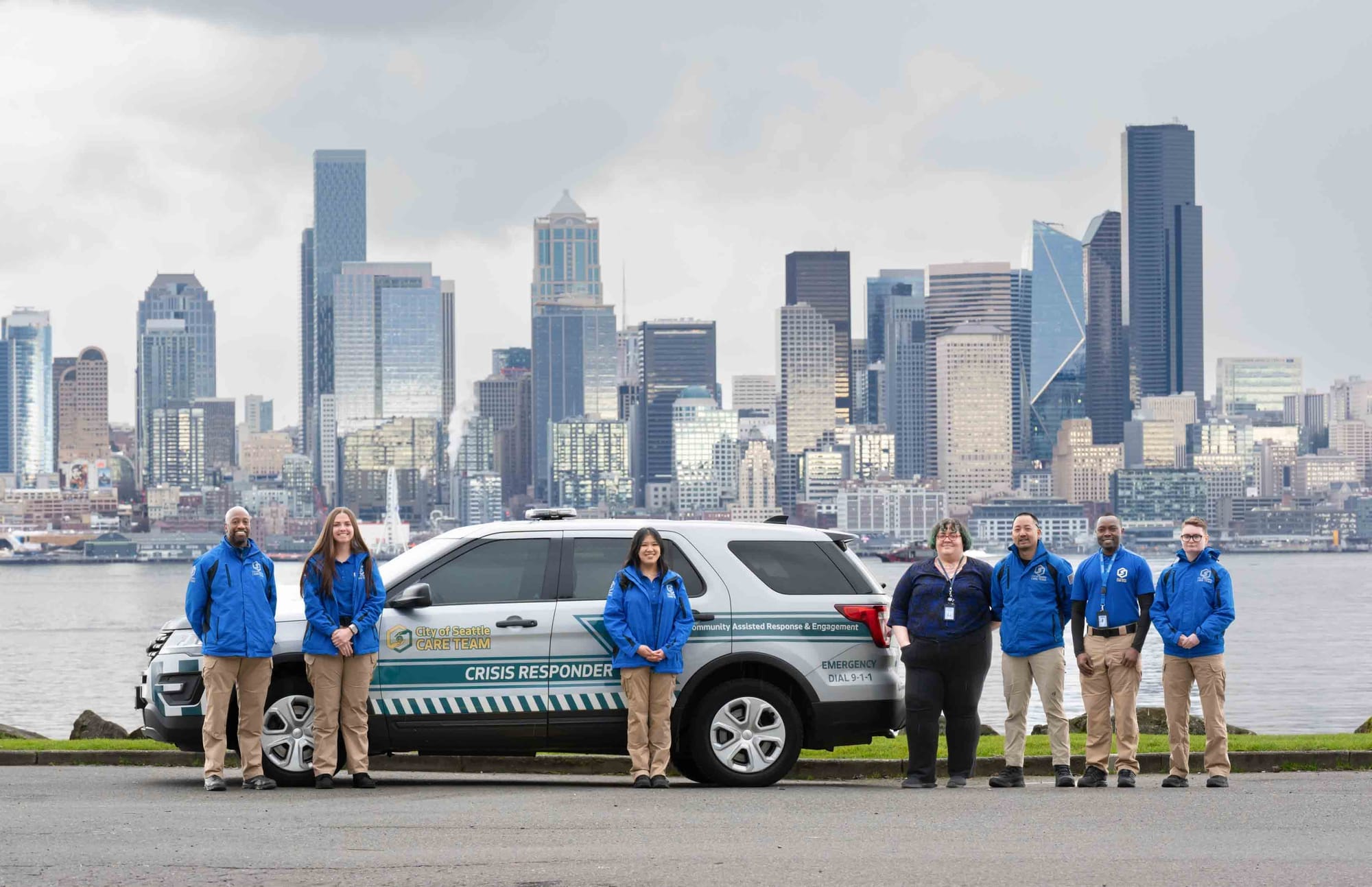
Aside from civilian crisis responders–the Community Assisted Response & Engagement (CARE) department — Harrell plans to ignore points two and three and recreate the status quo ante. Once again–to the benefit of bad guys, the detriment of good cops, and in a raw deal for taxpayers–we would burden a sworn force of 1,400 plus officers with lots of things civilian staff can do equally well for less.

To add insult to injury, Harrell just offered SPOG a contract that gives officers a big raise — a 42% pay increase in just five years–while hamstringing the deployment of CARE through a list of arbitrary restrictions.

Seattle hired 84 police officers in 2024 and lost 83 to separations, netting one officer. (Seattle Police Department)

One of the more head-scratching examples: if someone is having a mental health crisis on the sidewalk outside of a Safeway, CARE can be solo dispatched. But if they are just inside the Safeway, sworn officers must also be dispatched — a needless waste of officers’ time and talent.

But what’s more egregious is that Harrell is negotiating dispatch protocols with SPOG at all. Albuquerque’s CARE equivalent has handled more than 100,000 calls for service. They clearly know how to successfully and safely operate civilian crisis response and Seattle should simply be adopting their well-proven protocols rather than letting SPOG put an uninformed thumb on the scale.

Wilson in contrast understands the upside for all involved (well, except criminals) of building back better.  From her platform:

Seattle’s CARE Department, our primary alternative response for crisis calls, has shown success — but its expansion has been stymied by a poorly negotiated police contract, which caps the department at just 24 civilian responders. We are still deploying highly paid, highly trained armed officers to mental health and other non-crime calls they’re neither suited to nor needed for — and many other jobs civilians can do, from directing traffic at events to taking down crime reports. This crowds out proactive police work and limits the immediate availability of officers to respond to crimes in progress.

Katie WIlson’s platform

Here’s the kicker, from which all good things follow: based on what other cities are already doing, hiring 400 civilian responders to unburden officers of all those non-crime calls will only cost as much as 300 sworn officers.

And that civilianization dividend would be a big deal.

Where we could go from here

At this point, I will ask you to focus on one fact and one happy assumption.

The fact is that Harrell’s plan is to staff up to more than 1,450 sworn officers and fund CARE team responders as a net addition on top of that. So it’s 100 percent certain Wilson wouldn’t need to come back to taxpayers for more than what her opponent is already committed to spending to implement a civilianization plan.

Mayor Bruce Harrell poses with the CARE department team, which has grown under his watch, but its work remains closely prescribed by the police contract. (City of Seattle)

The happy assumption is that the civilianization plan is doable. The good news is that it is, as I’ll explain. But first I want to focus on the possibilities it unlocks.

If within the same public safety budget we were going to spend anyway we were to free up 100 sworn officers’ worth of salary, benefits, and overhead, we could do any combination of three things:

(1): We could go ahead and hire an additional 100 sworn officers. This would result in 200,000 more hours per year of sworn officer time focused on proactive police work and handling crime than the city has ever had. 

It’s enough to staff every “Urban Village” with a best practice Bill Bratton-style community policing team of a sergeant and foot patrol officers fully dedicated to 100% proactive police work.

(2):  Accountability for results is at the heart of Bill Bratton-style community policing. In my department, if you were a police officer and wanted to make sergeant, a sure-fire way was to reduce crime on your beat. If you were sergeant and wanted to make lieutenant, a sure-fire way was to reduce crime in the district (based on neighborhood) you supervised. 

We could take the next logical step and offer annual cash bonuses for excellence at proactive police work and community policing where it’s needed most. It’s enough for (say) 200 of the best line officers and street supervisors to get as much as half their salary as an award.

Over the course of their career a great beat officer could earn more than $1 million in bonuses, making Seattle a magnet for the very best police officers and aspiring officers in the country.

(An albeit less exciting but more tried and true approach to achieving the same goal would be using the dividend to create a budget for master police officers and street supervisor roles. With a strong community policing track record, officers and sergeants could be promoted in place to continue frontline work at a higher base salary.)

(3): We could split the difference, allocating (say) half of the civilianization dividend to staffing 100% proactive teams that could take rotational assignments.

Little Saigon behind the eight ball? Ongoing trouble at Magnuson Park? Hot rod street takeovers on Capitol Hill? Teams could be assigned to take responsibility for hotspots and chronic problems until they are well and truly fixed.

And we’d still have a budget to reward excellent police work.

The cash bonuses are my idea, but community policing best practices are already in Wilson’s platform:

Pilot a problem-oriented, place-based model of public safety, assigning individual police officers and civilian responders to several specific neighborhoods to increase responsiveness and focus on reducing crime, crises, and disorder.

Why the right thing to do is obvious

The Bizarro World thing you need to internalize about the public safety discussion in Seattle right now is that the fact that sworn officers tend to get burdened with tasks that are neither proactive police work nor handling serious crime is something the profession has been wrestling with since the 1960s.

While the will and wherewithal to do something about it has varied by place and time, it was never, ever regarded as a good thing.

Getting officers out from under it was always regarded as a plus.

For example: the President’s Commission on Law Enforcement and Administration of Justice recommended the creation of an unarmed civilian position, a community service officer (CSO), within police departments in 1967.

The Worcester, Massachusetts police department proved community service officers could help (with majority approval of the role from sworn officers) in 1975. 

I had an FBI Law Enforcement Bulletin with a feature article about civilianization on my desk, in a police department, in 1994. 

Today, lots of cities and police departments are way out ahead of Seattle at unburdening officers from tasks that don’t require a gun and the power of arrest.  The infographic below provides a mapping of how proven, already deployed roles in other cities could enable Seattle police officers to enjoy the same relief. 

Civilian roles fall into three basic categories (shown left to right on the infographic in their relative numbers from most to least):

  1. Community service officers, who are general purpose responders when a gun and the power of arrest isn’t needed.
  2. Crisis responders, who are specialists at dealing with mental health and related problems (this includes Seattle’s CARE team).
  3. Report takes and investigators, who can handle the paper work and documentation of after the fact theft reports and processing accident scenes.

These are all proven and successful roles just waiting for the right leadership to deploy (in the right numbers) here in Seattle.

A variety of approaches to civilianizing police work has been taken across North America, and it’s largely working. (Bryan Kirschner)

Each of these roles cost less than sworn officers. At maximum step, CSOs in San Jose make 55% of a sworn officer’s salary. Denver report technicians make 75%. And CARE workers here make 87% (that’s prior to Harrell’s latest pay raise for SPOG members and not counting sworn Seattle officers’ longevity and body camera pay).

Civilianizing: good for good cops and bad for criminals

But the most important reason for civilianizing non-crime tasks isn’t financial. It’s good for good cops and bad for criminals.

Imagine an officer who chose the job for all the best reasons. She’s also been well-trained in Bill Bratton-style community policing.

So she’s psyched to have been assigned to Little Saigon, because she knows a good beat officer can make a real difference in communities that are up against it because of rampant criminal activity.

To that end, she’s doing directed foot patrol in the worst hot spot in the neighborhood when she’s called away. For the third time this week, she has to respond to 911 calls about a shouting  match between neighbors over a dog pooping in the yard next door. Only this time the owner is also saying the neighbor trespassed in order to deposit the droppings on his porch.

So now on top of everything else she has to visit said porch to determine if there is indeed a smelly pile of poo there or not.

After she clears that call–at least for today–she’s diverted from getting back to executing on her anti-crime game plan by another call.

A homeless woman who is a frequent flyer for mental health episodes is lurching around a 7-11 parking lot crying and screaming for help finding her baby (which she’ll need to be reminded she doesn’t actually have). 

At first she’s relieved because the CARE team will take care of it.

But then there’s a second 911 call: the woman has entered the store and is limping through the aisles wailing. So now the officer has to respond as well because CARE’s not allowed to handle the exact same situation on their own if it’s inside a building instead of outdoors.

When she hopes she’ll finally be able to return to where her beat needs her most, she’s diverted to a car crash.

Instead of following up on local business owners’ complaints about sketchy characters gathering in a parking lot after sunset and scaring off customers, she spends the rest of her shift taking he-said, she-said statements about a car running a red light and photographing skid marks on asphalt.

This is an illustration of a triple whammy of crummy.

First, it wastes public safety dollars that could be better spent (including as described above, adding more police officers, rewards for excellence at community policing, or both) by over paying for handling the non-crime calls.

Second — and worse for the officer — it needlessly randomizes the officer and interferes with carrying out a focused deterrence strategy based on time, location, and people.

Good beat officers exploit three criminological facts (assuming they’re freed up to do so). First: crime clusters geographically, with about 10% of locations accounting for 50% of crimes. Second: a few offenders commit a disproportionate amount of crime (also about 10% and 50%). And finally: deterrence is a function of the perceived likelihood of getting caught.

So if you can raise the fear of getting caught in the worst bad places and among the worst bad guys, you can make a real difference on your beat.

Third and every bit as important: we all only have so much gas in the tank for doing hard work every day. We’ve bogged her down, body and mind, in stuff that doesn’t need to be her problem, tiring her out for tackling what motivated her to take the job in the first place. 

A vote for Harrell is a vote to deprive Seattle police officers of the opportunity to have more focused and fulfilling jobs like those in Orange County, San Jose, Denver, and the other cities referenced in the infographic.

At the end of the day, sworn officers are the only municipal employees we have trained and equipped to deter, confront, and arrest determined or violent criminals.  

If we’re serious about making Seattle a bad place to be a bad guy, the very best thing we can do is to invest in freeing sworn officers to spend every bit of time, talent, and energy on doing just that.

A few words about SPOG

Existing labor agreements between the city and the Seattle Police Officers’ Guild (SPOG) make it possible for SPOG to obstruct civilianization.

Three officers standing around a squad car
Officers at the Seattle Police Department spend too much time in their squad cars and not enough time walking a beat and deterring and solving crimes. (Seattle Police Department)

But I want you to consider what that would mean in relation to these proposals.

Standing in the way of Seattle getting more officer hours per year devoted to proactive police work and handling crime than the city’s ever had is straight up pro-criminal.

Standing in the way of Seattle police officers getting big rewards for excellent community policing is straight up anti-good cop. 

There’s no middle ground.

If SPOG isn’t willing to do the right thing and lead, follow, or get out of the way, it needs to be pushed out of the way.

A city charter amendment could reboot public safety in Seattle. (An option referenced by Seattle Councilmember Andrew Lewis in 2023 during the Harrell administration’s sluggish rollout of the CARE team).

State legislative action could make civilianization non-bargainable provided no presently employers officers are losing their jobs. (As it should be: the city does not have to bargain with SPOG to hire civilian mechanics to service cruisers or civilian accounting clerks to process payroll, even though using sworn officers to do those jobs would increase the raw number of sworn officer jobs.)

SPOG shouldn’t be allowed to prevent law abiding Seattle citizens and Seattle’s best police officers from having nice things. A better mayor than Harrell would have started tackling this issue on day one in office. 

But it’s not too late to change course this election day.

A Note on Bratton’s Pivot from “Three R’s” to “Three P’s”

As a police chief, Bratton was willing to tackle a big problem facing the profession head-on. By the 1970s U.S. police departments had committed to a strategy of reacting to 911 calls, random patrol, and reactive investigation — or the three R’s. And in his own words: “Clearly, what we were doing was not working.”

Community policing emerged from police leaders, academics, criminologists, and elected officials thinking about what could be done differently. Its strategic principles were, instead, “partnership, problem-solving and prevention.”

The glass half full take is that on his watch (and many other places) community policing was effective at reducing crime and fear of crime. The glass half empty is that since its heyday in the early 1990s, many police departments–including  New York City’s and New Haven’s–went back to the old way of doing things.  

To this day there is still a tug of war in the profession between advocates of community policing and those who prefer the old ways.

The post Op-Ed: Katie Wilson’s Civilian Safety Plan Would Unlock More Effective Police Department first appeared on The Urbanist.

Read the whole story
Share this story
Delete
Next Page of Stories